
Stilpnomelane
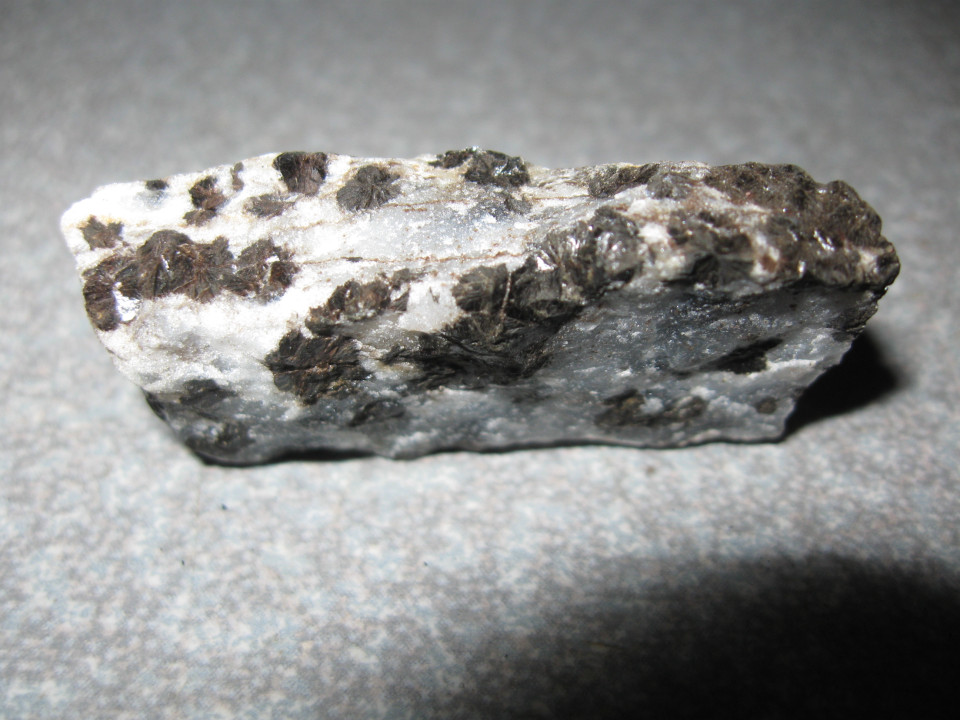
Stilpnomelane found at Blanchard Hill (south of Bellingham, WA)
WHAT IS IT?
-
A phyllosilicate mineral having the formula K(Fe++,Mg,Fe+++)8(Si,Al)12(O,OH)27•n(H2O).
-
Phyllosilicates, also known as "sheet silicates", form parallel sheets of silicate tetrahedra with Si205
-
All phyllosilicates are hydrated — contain water or hydroxyl groups.
-
Often looks like biotite
-
Contains banded iron or iron floret formations
-
Hardness: approximately 4
HISTORY
-
Named in 1827 by Ernest Friderich Glocke using the Greek words stilpnos (shining) and melanos (black)
-
First discovered in Moravia, now part of the Czech Republic
WHAT TYPES ARE THERE?
-
Colors: red, dark reddish brown, dark green, brown, golden brown, black
-
Related minerals in the Stilpnomelane Group include:
-
Chalcocite - Cu2S
-
Franklinphilite - K(Mn)(Si,Al)(O,OH)•n(HO) (with n~6)
-
Lennilenapeite - K6-7(Mg,Mn,Fe++,Fe+++,Zn)48(Si,Al)72(O,OH)216•16(H2O)
-
Parsettensite - K2Mn8(Si,Al)12O26(OH)1
-
WHERE IS IT FOUND?
-
Stipnomenlane is fairly rare
-
Found in the Czech Republic, New Zealand, & U.S. (Blanchard Hill, WA; Antwerp, NY; Saint Peters, PA; Western VT; Minnesota-Michigan iron range)
-
Collection sites in Washington State:
-
Blanchard Hill (south of Bellingham)
-
Alger
-
WHAT IS IT USED FOR?
-
Rock collecting
-
Jewelry


