Quartz
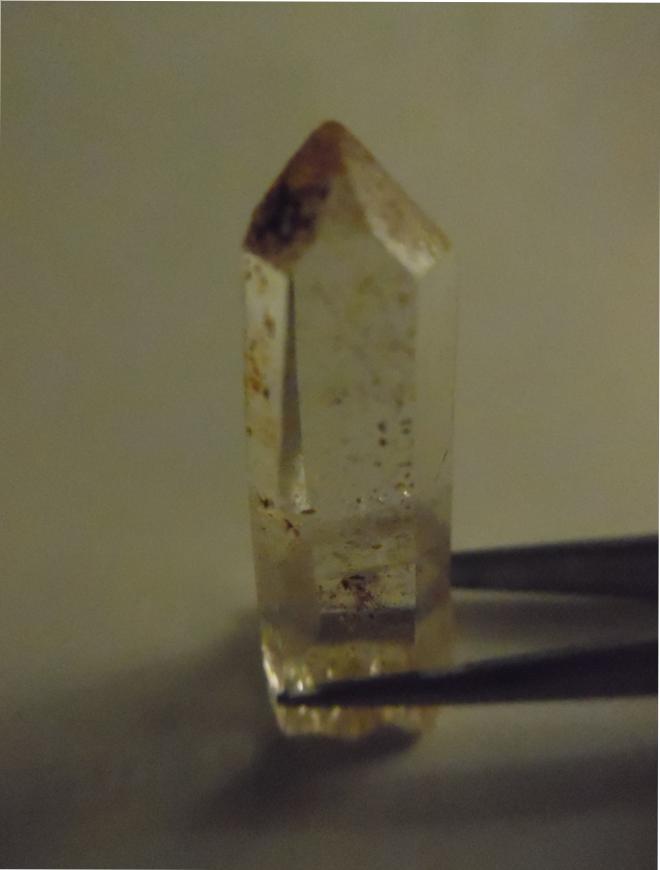
Quartz Crystal found at Hansen Creek (west of Snoqualmie Pass)
WHAT IS IT?
-
Silicon Dioxide (Si02) - Constitutes 12% of the earth’s crust (2nd most abundant mineral after feldspar, which constitutes up to 60%)
HISTORY
-
The name is derived from the German word "Quarz'. The Middle High German name is “twarc", which has roots to the Slavic word “Tvrdy", meaning "hard"
-
The Chinese used smokey quartz to make sunglass lenses in the 12th century
-
Used by ancient Mediterranean cultures (Minoan, Roman, Greek) for impression seals (intaglios), jewelry and tools (knives)
TYPES OF QUARTZ
-
There are many varieties (some are semi-precious gemstones). This is an incomplete list:
-
Agate- multi-colored, banded, translucent or semi-translucent chalcedony
-
Amethyst - clear purple colored quartz containing trace amounts of iron with transition metals
-
Ametrine - a combination of amethyst & citrine
-
Aventurine - a green translucent chalcedony that shimmers due to Inclusions (usually containing mica)
-
Carnelian - a translucent, reddish-orange chalcedony
-
Chalcedony - a white or light colored material consisting of a mixture of cryptocrystalline quartz (microscopic crystals) & moganite
-
Citrine - quartz that contains iron pigmentation resulting in a yellow to brown color. It is indistinguishable from yellow topaz except for hardness (topaz is harder). It is often made by heat-treating amethyst or smokey quartz
-
Chrysoprase- a green variety of chalcedony that is colored by nickel oxide
-
Dumortierite quartz — quartz that contains dumortierite crystals (fibrous aluminum-boro silicate)
-
Heliotrope or Bloodstone — a green variety of chalcedony containing red inclusions of iron oxide
-
Jasper - a cryptocrystalline opaque variety that typically has a red or brown color
-
Milky quartz - an opaque white appearance that is caused by minute inclusions of liquid, gas, or a combination of the two. It is the most common variety of quartz and is found almost anywhere.
-
Mtorlite or Chrome Chalcedony — a green variety of chalcedony that gets its color from chrome
-
Onyx is a form of agate that has parallel evenly spaced bands of black and white
-
Prasiolite (aka green quartz or vermarine) - a rare green form of quartz once mined in Brazil & Poland, now only synthetic
-
Rock crystal or clear quartz - colorless & transparent (clear)
-
Rose quartz - a dull pink to rose colored variety that contains iron, manganese, and/or titanium. A rarer variety contains phosphorus and aluminum. Some exhibits diasterism (displays a luminous star pattern when illuminated from back)
-
Sardonyx - similar to onyx but has brown, orange, red, and white banding
-
Smoky quartz - varies from being translucent gray to an almost opaque grey-brown due to natural irradiation. There are a number of varieties (e.g._ Moran, Cairngorm). Contains uranium trioxide
-
Tiger's eye - a fiberous variety that exhibits chatoyancy and is usually orange to red-brown in color
-
-
Quartz-like or quartz derived silica minerals:
-
Coesite — danse polymorph of quartz found at meteorite impact Sites
-
Cristobalite — high-temp polymorph of quartz found in volcanic rock
-
Lechatelierite — an amorphous silica glass formed by lightning strikes
-
Moganite — a monoclinic polymorph of quartz discovered in 1984 (has same chemical composition, but a different structure). Typically constitutes from less than 5% to more than 20% of the mass of a typical chalcedony
-
Stishovite — a very dense polymorph of quartz found at meteorite impact sites (denser than coesite)
-
Tridymite — another high-temp polymorph of quartz found in volcanic rock
-
WHERE IS IT FOUND?
-
Quartz is found worldwide (e.g. most beach sand contains it; granite contains it). Agate, jasper, and milky quartz are common.
-
Amethyst— Brazil, Mexico, Uruguay, Russia, France, Namibia and Morocco (best sources)
-
Aventurine —Austria, Brazil, Chile, India, Spain, Russia, Tanzania
-
Carnelian — Brazil, India, Uruguay
-
Citrine — Brazil
-
Chrysoprase — Australia, India, Russia, USA
-
Heliotrope — India primarily. Also, Australia, Bran, China, Scotland (Isle of Rum), USA
-
Onyx — Brazil, Madagascar, Uruguay
-
Parsiolite — no current natural sources. Made by heat-treating amethyst and citrine (primarily from Brazil)
-
Rose quartz - Brazil, Madagascar, India, United States, Japan, Africa, Germany and Switzerland
-
Sardonyx — Brazil, Czech Republic, Germany, Sri Lanka, Uruguay, USA (Great Lakes, Oregon)
-
Smoky quartz— Australia, Brazil, Canada, China, England, Ghana, Hungary, India, Madagascar, Mozambique, Scotland, Slovakia, Sweden, Switzerland, and the United States (in numerous states, esp. Arkansas; also Crystal Park near Dillon, MT)
WHAT IS IT USED FOR?
-
Jewelry, carvings, collector specimens, heat lamps, prisms, lenses, paints, refractories, abrasives, precision instruments
-
Has piezoelectic properties - useful for electronic oscillator crystals (digital watches, computers & radios) & sensors


